Claims have existed for many centuries that the Earth might possess other natural satellites besides the Moon. Several candidates have been proposed, but all such claims have proven false. The Moon is Earth's only known natural satellite.
While several genuine scientific searches for "second moons" were undertaken in the 19th and 20th centuries, the field has also been the subject of several non-scientific proposals and possible hoaxes. These possible hoaxes, which were about objects of specific size and orbits, were poorly founded and all have been disproven.[1]
Although the Moon is Earth's only known natural satellite, there are a number of near-Earth objects with orbits that are in resonance with Earth. These can be mistaken for natural satellites and are sometimes glibly referred to as "second moons".[2] Quasi-satellites, such as 3753 Cruithne, orbit Earth in 1:1 resonance but also orbit the Sun. Earth trojans, such as 2010 TK7, follow the same orbital path as Earth, either trailing or following, in the vicinity of the Earth–Sun Lagrangian points.
There have been large generic searches for small moons, actual proposals or claimed sightings of specific objects in orbit, and finally, analysis and searches for those proposed objects. All three of these have failed to confirm a permanent natural satellite.
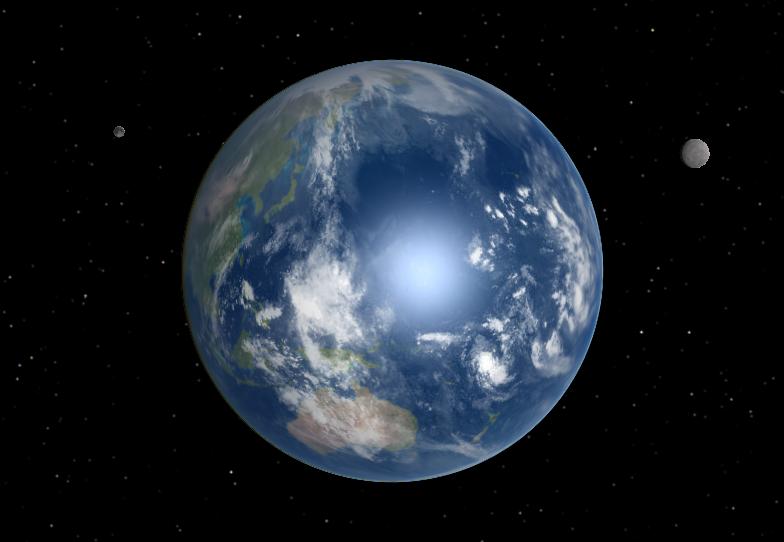
While several genuine scientific searches for "second moons" were undertaken in the 19th and 20th centuries, the field has also been the subject of several non-scientific proposals and possible hoaxes. These possible hoaxes, which were about objects of specific size and orbits, were poorly founded and all have been disproven.[1]
Although the Moon is Earth's only known natural satellite, there are a number of near-Earth objects with orbits that are in resonance with Earth. These can be mistaken for natural satellites and are sometimes glibly referred to as "second moons".[2] Quasi-satellites, such as 3753 Cruithne, orbit Earth in 1:1 resonance but also orbit the Sun. Earth trojans, such as 2010 TK7, follow the same orbital path as Earth, either trailing or following, in the vicinity of the Earth–Sun Lagrangian points.
There have been large generic searches for small moons, actual proposals or claimed sightings of specific objects in orbit, and finally, analysis and searches for those proposed objects. All three of these have failed to confirm a permanent natural satellite.

No comments:
Post a Comment